


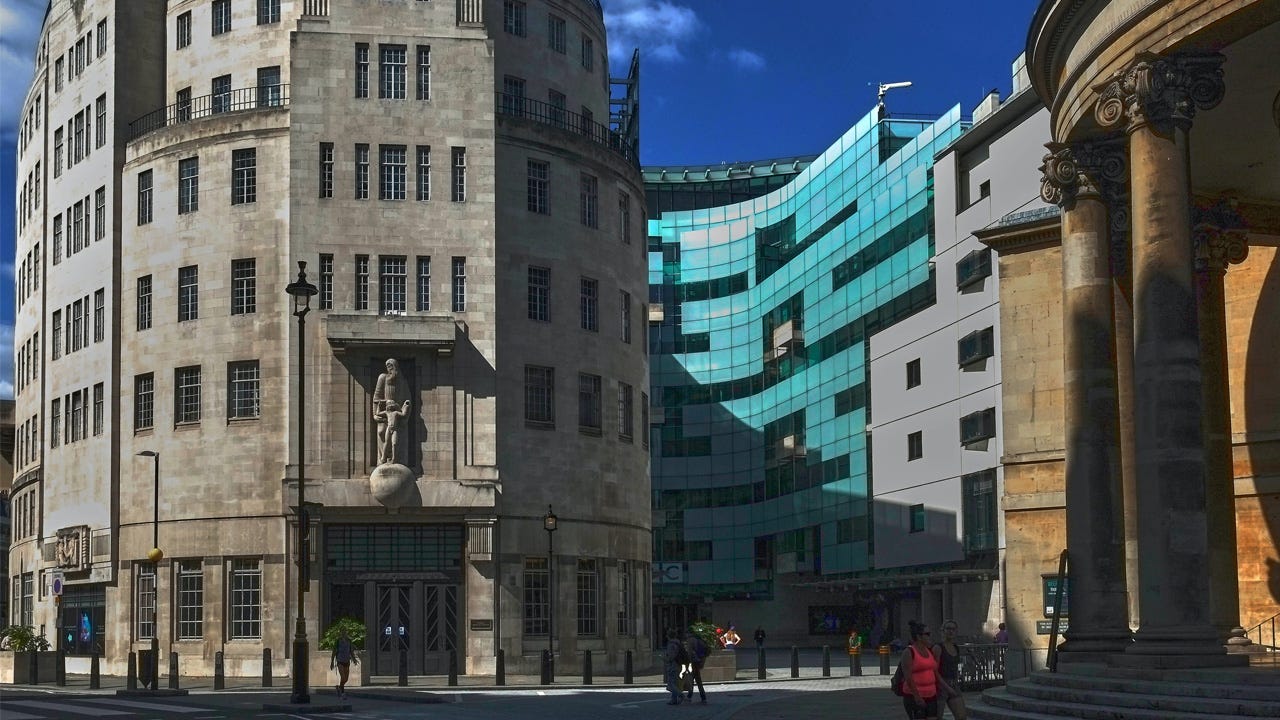
Today I’m heading up to the Edinburgh TV Festival, where much of the British television industry will spend the next few days talking about its future. At the same time, the government’s Watch this Space consultation is asking some pretty fundamental questions about the future of UK media, with responses due by the end of the month. And, of course, the current BBC Charter runs out at the end of 2027.
So it feels like a good moment to think a bit bigger.
The future of the BBC and public-service broadcasting is something we’ve talked about on The Media Club for years, going right back to when the podcast was The Guardian’s Media Talk. The arguments are often about individual decisions: the licence fee, BBC cuts, Channel 4, Freeview, prominence, whether a particular service should survive.
I also occasionally get called in by the BBC, during one of its regular bouts of self-flagellation, to provide an independent view on programmes about the licence fee or the future of the Corporation. I recently spent an hour doing just that on BBC Radio Scotland, and it reinforced something I’ve felt creeping up over the past few years: the public’s relationship with all of this has changed.
The era of the must-pay TV licence has splintered. Partly that’s the rules: you don’t need a licence if you don’t watch live television or use iPlayer. But it’s also because people’s media habits have changed. For a growing number, the BBC simply isn’t the unbreakable backbone of their television and radio lives that it once was.
There’s another problem too. A growing minority don’t trust BBC News. Some of that distrust is encouraged by people with their own agendas; some of it is the result of the BBC’s own mistakes. Much of the criticism is unfair. But the perception exists, and the structure of the BBC means arguments about its journalism, its funding and its relationship with government become tangled together again and again.
When I talk to colleagues in television about the licence fee, the response is often that the current system is the best of a bad bunch. And they’re often right. It’s the least-worst option. Grin and bear it. Besides, the government probably doesn’t have the will to replace it anyway.
I understand that argument because I find it hard to wrench myself away from it too. But I also wonder whether we’ve all gone a bit native.
Those of us who work around broadcasting can spend so much time comparing alternative funding mechanisms and worrying about the consequences of change that we miss what’s happening outside. The public has already changed its relationship with the BBC. The genie is out of the bottle.
If you believe in public-service broadcasting, as I do, I don’t think the answer can simply be to defend the existing system until it becomes impossible to do so. We have to think bigger. So I’ve tried to start somewhere different.
If we were designing British public media for the 2030s, rather than trying to preserve the broadcasting system we inherited from the 20th century, what would we build?
I’ve spent the past few weeks following that question, probably rather further than I originally intended.
The result is Public Media 2028, a proposal that starts with the things we actually want public media to do, and then asks what organisations, funding and structures could best deliver them.
I’d create an independent BBC News, ultimately funded from a £20bn endowment; publicly funded organisations for Nations & Local and Culture & Kids; and a separately funded World Service.
The biggest change would be entertainment. I’d bring together the BBC’s entertainment operation, Channel 4, UKTV and BBC Studios into a new publicly owned but commercially run iPlayer & Sounds Corporation.
They aren’t the same organisations, and that’s the point. The BBC brings reach, iPlayer and Sounds and huge entertainment brands. Channel 4 brings creative risk and its challenger public-service role. UKTV brings commercial and advertising expertise. BBC Studios brings production, rights and an international business.
Together, I think they could form a British media company with the scale to compete properly for audiences, subscriptions, advertising and intellectual property, while using its commercial success to invest in more British programmes.
It also means confronting the licence fee. My model replaces it with direct public funding for the things the market won’t provide, alongside a free tier and £7 and £15 monthly subscriptions. The base case assumes half of UK households pay, but I’ve made the model interactive, so you can change the take-up, prices and customer mix and see what happens through to 2035.
These are deliberately big swings. A £20bn news endowment is a huge, complex, undertaking. Breaking up the BBC and putting its entertainment assets together with Channel 4 and UKTV would be an enormous change.
But keeping everything broadly as it is is a choice as well.
Linear television is declining, the licence fee is weakening and the international companies competing for British audiences operate at a scale our broadcasters increasingly can’t match individually. At the same time, I still want independent news, children’s and educational content, local and national services, British culture and those occasional programmes and events that bring millions of us together.
So the question I’ve tried to answer isn’t how do we save the BBC?
It’s what are we trying to save, and what’s the best way to make sure it’s still thriving in 2035?
I’ve put the whole proposal, the numbers, the assumptions and an interactive model online:
Have a play with it. Change my assumptions. Tell me where I’m wrong. And, most importantly, tell me what you’d do instead.