


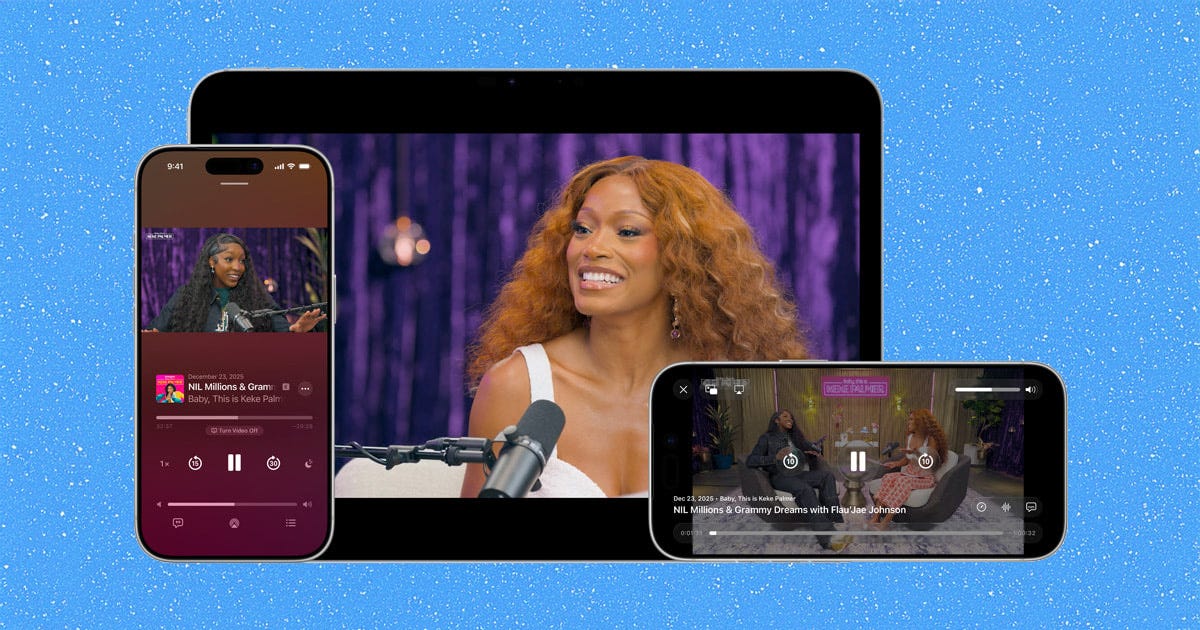
Apple have just announced it’s bringing native video podcasting into Apple Podcasts. This isn’t just another feature update, it’s Apple acknowledging something that more and more creators have been saying: their audiences want video. And platforms that don’t serve it risk not being seen as true content destinations.
Apple Podcasts has actually had video since the beginning, there’s even been points where they encouraged podcasts to do it - around 2013 if I can remember right! It didn’t last long. This time Apple is embedding video deep into its podcast experience rather than distributing it as a side-effect of RSS. By embracing HLS video, the same adaptive streaming technology behind Apple’s video services, Apple is staking a claim that video podcasts should feel as seamless and integrated as audio has always been. They talk about users being able to switch between audio and video within the app, flip to full horizontal display, and download videos for offline use.
There’s a clear strategic motive here. Creators have already been making their shows available in video form on platforms like YouTube and Spotify because that’s where audiences, particularly new and younger ones, are spending time and attention. Whilst audio-first creators may grumble, video isn’t just complementary; it’s a core part of how people discover and engage with podcasting now.
But there’s a deeper shift under the surface.
Apple Is Now Part of the Ad Stack
Apple doesn’t seem to be charging creators or hosting providers to distribute video. That part stays very much in the open RSS tradition. But it does seem to be charging participating ad networks an impression-based fee for serving dynamic video ads inside HLS video. That is new territory for Apple Podcasts.
This changes the economic architecture:
Video podcasts can now include dynamically inserted video ads, including host-read spots.
Apple becomes part of the monetary flow, not just the distribution layer.
Ad networks like Acast, ART19, Omny Studio and Simplecast are the early launch partners.
Does that mean monetisation for video podcasts is no longer just about where you host your RSS and who sells your audio inventory? Apple seems to now be part of the delivery and billing chain for video ad impressions. Is that the first step towards Apple taking more of a platform-level share of podcast revenue.
That’s a substantive evolution from how podcast advertising has worked historically, where the network stitches ads into audio and the app simply downloads or streams that file. Even Spotify has largely eschewed this with its partner programme, concentrating on ad-free listening and sharing subscription revenue with creators. With HLS, the ad decisioning and delivery is happening at the point of playback, which is where Apple sits.
Syncing Ads Across Formats Isn’t Trivial
One question Apple hasn’t fully answered is how this works in practice when a listener switches between audio and video formats of the same episode.
If someone is listening to an audio episode with an ad break at 15 minutes, then chooses to watch from the same point, how does the ad system behave?
A unified platform - where one ad call determines both audio and video creatives in lockstep?
Separate pipelines where audio and video ad logic run independently - risking mismatched or repeated impressions?
Video-first display with audio fallback where video drives the break and audio follows?
Different hosting partners and networks may implement different approaches, and that’s before you consider host-read sponsorships baked into audio that have no video equivalent. Those complexities are not trivial, and they go to the heart of what “seamless” will actually mean for creators and advertisers.
This isn’t just technical hair-splitting. It goes to the economics of audience behaviour. Switching formats might be a user convenience, but if that switch triggers a new ad break that feels like a fresh impression, advertisers care. So do podcasters, because earnings hinge on those settled definitions of an “impression”.
Update: James Cridland suggests that it will follow the Spotify model of taking the audio from the video.
Platform Dynamics Matter
It’s also worth stepping back and recognising what Apple’s move does to content distribution strategies.
A few years ago, the conversation I was having with creators was whether you even needed video or whether podcasting should remain about audio conversations. That tension between defending audio’s unique strengths and acknowledging the reality of video consumption was the theme of my posts about video this time last year.
Today, few serious publishers think of podcasting as purely audio. Yes, audio is portable, intimate and special. But creators who want growth and relevance are already thinking in terms of multi-platform, mixed-format strategies.
Apple’s move formalises the move to video for podcasting with the core consumption apps - Spotify, YouTube and Apple - now all putting video front and centre.
But it doesn’t automatically solve the discovery problem that video podcasts still face inside Apple Podcasts. Search, recommendation and trending behaviour on YouTube is a very different engine to what we see in most audio podcast apps. Apple will need to lean into that behind the scenes if video podcasts are to feel native rather than bolted on.
What This Means for Creators
For anyone making a long-form talk show or interview series, this is a positive evolution. For your Apple audience - one feed, one show page, one analytics set. You won’t have to maintain separate audio and video listings just to get discoverability and usage data that makes sense.
But monetisation logic now gets more interesting.
Audio CPMs (and subscriptions) remain vital.
Video CPMs tend to be higher, but they also need different creative and production rigour.
Mid-roll host reads, dynamic spots and video overlays all coexist now — and synchronising them across formats will require editorial and technical thought.
In the earlier phases of the shift to video I wrote about how creators needed to adapt workflows for platforms like YouTube and Spotify, retooling their content for a video audience rather than simply republishing audio. That remains true.
For Creators, of course, this does add even more complexity. You’ve got a videos ads model on Apple Podcasts, an ad-free video partner programme on Spotify and a separately architected ad network on YouTube. You also may have an Apple Podcasts subscription service (one tier, audio only, no data sharing) alongside a multi-tier subscription offer on Patreon, or a multi-platform content offer on Substack. It doesn’t make it easy to explain to your audience how to consume your stuff.
Perhaps there is some light at the end of the tunnel, Omny and Acast are two hosting/ad providers who are part of this announcement as well as the one Spotify made at the beginning of the year.
Acast’s move into video spans not only the Spotify announcement and this Apple one, but they also announced an ‘MCN’ for their podcast partners on YouTube. This allows them to sell inventory on YouTube in their partners’ podcast channels. If they combine video ad sales and distribution across Apple and YouTube as well as something on Spotify, that’s potentially quite powerful. But it does require the scaling of a video product for their CMS and a new video advertising project. A busy time for their team.
For Triton - the operators of Omny Studio - their business needs to evolve too. They’re slightly different to Acast. They provide a content management system for podcasters, but they also provide the plumbing to sell your own advertising and to connect to third party ad networks. It’s a more business to business operation. They’ll have to work to align their pipes to deliver the content and ads to the destinations their customers needs. A tough task for their product people too.
Outside of these two, it remains even more of a mess, and complex for podcasters to navigate.
Isn’t it time Apple, Spotify and YouTube worked together for the good of their content providers?
Update: Stephen Robles has a video walk through here:
Great write up, Matt. A lot of these things are what I'm very actively thinking about!